
Mathematics is an important subject that helps students develop problem-solving abilities, logical thinking, and confidence. However, many students find math challenging because they struggle to understand concepts, solve equations, or remember formulas. With the right learning strategies and consistent practice, students can gradually improve their math skills.
Today, parents and students are also exploring Online Tutoring in United States to make math learning easier and more accessible. Personalized lessons, interactive activities, and one-on-one guidance can help students understand difficult topics at their own pace.
Whether a student is learning basic addition or advanced algebra, small changes in their daily study routine can make a big difference.
Here are 10 simple and effective ways to help students improve their math skills.
1. Practice Math Every Day
Regular practice is one of the most effective ways to improve mathematical skills. Students do not need to spend several hours solving problems every day. Even 15–30 minutes of focused practice can help strengthen their understanding.
Daily practice helps students:
Remember mathematical formulas.
Improve calculation speed.
Understand different problem-solving methods.
Develop confidence when solving questions.
Parents can encourage children to solve a few math problems every day to build a consistent learning habit.
2. Understand Concepts Instead of Memorizing Formulas
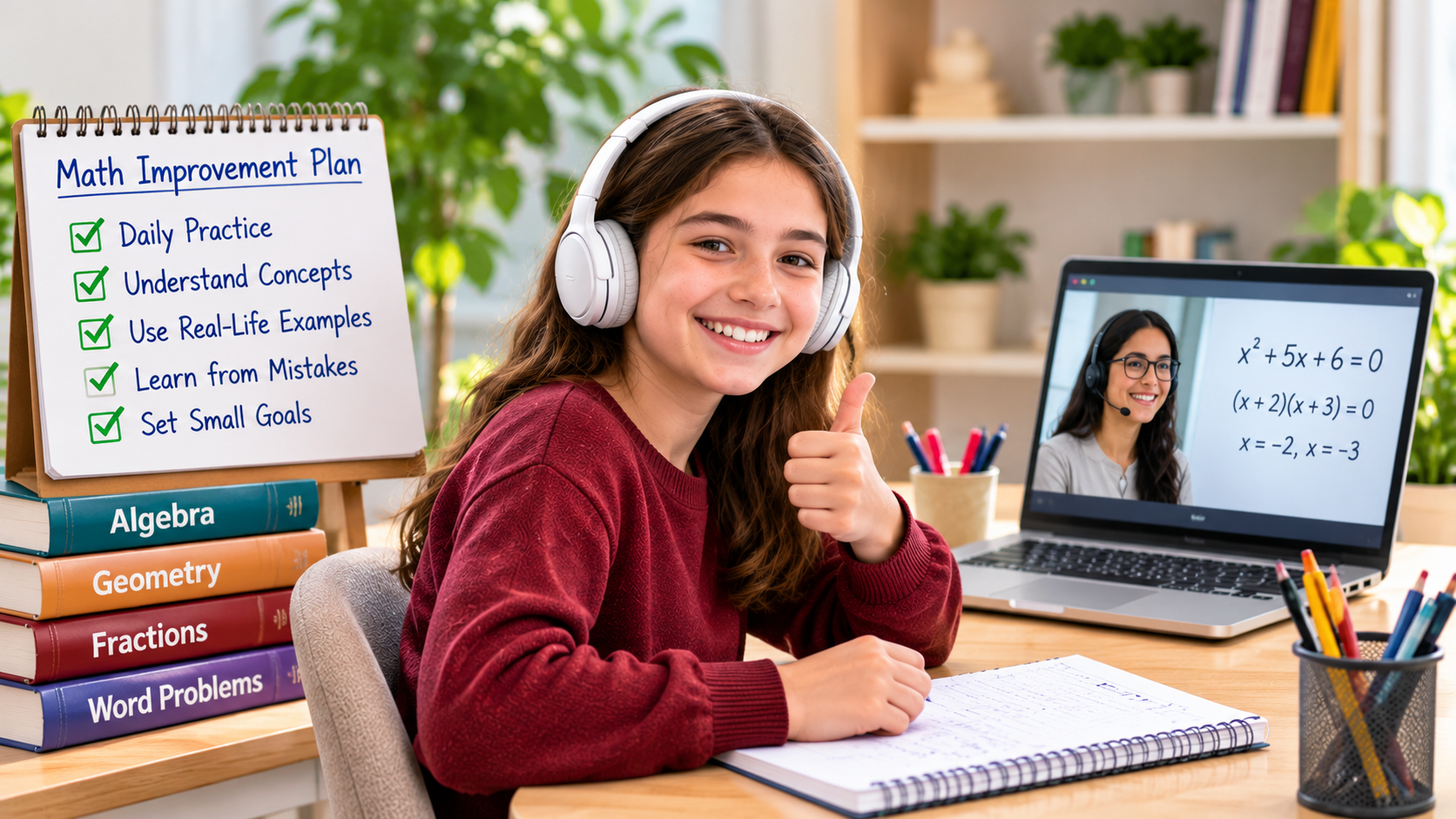
Many students try to memorize mathematical formulas without understanding how they work. Although memorization can sometimes be helpful, understanding the concept behind a formula is much more valuable.
For example, instead of simply memorizing the formula for the area of a rectangle, students should understand why multiplying its length by its width gives the total area.
Teachers can use real-life examples, diagrams, and visual explanations to make complicated topics easier to understand.
When students understand the basics, they can solve unfamiliar problems more confidently.
3. Connect Mathematics with Everyday Life
Mathematics is not limited to textbooks and classroom assignments. Students use math in many everyday activities, often without realizing it.
Parents can introduce simple mathematical activities at home, such as:
Calculating grocery bills while shopping.
Measuring ingredients while cooking.
Calculating travel time and distance.
Comparing prices and discounts.
Managing pocket money and savings.
These activities help students understand how mathematics works in real-life situations and make learning more interesting.
4. Break Difficult Problems into Smaller Steps
Some math problems look complicated because they involve multiple calculations or steps. Students may feel confused when they try to solve everything at once.
An effective approach is to divide a large problem into smaller, manageable steps.
For example, when solving a word problem, students should:
Read the question carefully.
Identify the important information.
Understand what needs to be calculated.
Select the correct mathematical operation.
Solve the problem step by step.
Check the final answer.
This method helps students develop logical thinking and avoid unnecessary mistakes.
5. Use Visual Learning Tools
Visual learning can make mathematics easier, especially for students who struggle with abstract concepts.
Charts, diagrams, number lines, shapes, and interactive learning tools can help students understand topics more clearly.
For example:
Number lines can explain addition and subtraction.
Shapes can help students understand geometry.
Graphs can make data interpretation easier.
Fraction models can explain parts of a whole.
Online learning platforms also provide interactive resources that make math lessons more engaging and easier to follow.
6. Learn from Mistakes

Making mistakes is a normal part of learning mathematics. Instead of becoming frustrated after getting an incorrect answer, students should understand where they went wrong.
Parents and teachers should encourage students to review incorrect answers and try solving similar problems again.
Students can maintain a mistake notebook where they write down:
The question they answered incorrectly.
The step where they made a mistake.
The correct method.
What they learned from the mistake.
This simple habit helps students recognize common errors and improve their problem-solving abilities over time.
7. Set Small and Achievable Learning Goals
Setting realistic goals can motivate students to improve their math skills.
Instead of trying to master an entire chapter in one day, students should focus on completing smaller learning targets.
For example:
Learn five new multiplication facts.
Solve ten algebra questions.
Practice fractions for 20 minutes.
Complete one geometry exercise.
Improve calculation accuracy.
Small achievements create a sense of progress and encourage students to continue learning.
Parents can also appreciate their children's efforts rather than focusing only on test scores.
8. Make Mathematics Fun Through Educational Games
Learning mathematics does not always have to involve textbooks and worksheets. Educational games can make math practice more enjoyable.
Some useful activities include:
Multiplication card games.
Math puzzles and brain teasers.
Number-based board games.
Online math quizzes.
Mental calculation challenges.
These activities encourage students to think quickly, recognize patterns, and develop problem-solving skills.
When students enjoy learning, they are more likely to participate actively and practice regularly.
9. Get Personalized Help from Online Math Tutors
Every student learns differently. Some understand mathematical concepts quickly, while others need additional explanations and practice.
This is where Online Tutoring in United States can make a meaningful difference. Online tutoring gives students access to personalized academic support without requiring them to travel to a physical learning center.
With one-on-one online tutoring, students can:
Receive individual attention from tutors.
Ask questions without hesitation.
Learn difficult concepts at their own pace.
Get help with homework and assignments.
Practice topics they find challenging.
Receive guidance based on their learning needs.
Personalized tutoring can help identify learning gaps and provide structured support to address them.
At Siri Education, students can explore one-on-one online tutoring designed to support their individual learning needs. Our approach focuses on making lessons engaging, understandable, and student-friendly.
10. Develop a Positive Attitude Toward Mathematics

A student's mindset can influence how they approach mathematics. When students believe that math is too difficult, they may avoid practicing or become nervous during examinations.
Parents and teachers should create a supportive learning environment where students feel comfortable asking questions and making mistakes.
Here are a few ways to encourage a positive attitude:
Appreciate consistent effort.
Avoid comparing students with others.
Celebrate small improvements.
Encourage independent problem-solving.
Remind students that mathematical ability develops through practice.
With patience, encouragement, and the right learning support, students can become more confident in mathematics.
Why Is Online Math Tutoring Helpful for Students in the United States?
Online learning has made academic support more accessible for students across the United States. Students can connect with tutors from home and receive guidance according to their academic requirements.
Online math tutoring offers several advantages:
1. Flexible Learning: Students can attend lessons from home and organize their learning around their daily schedules.
2. Individual Attention: One-on-one sessions allow tutors to focus on a student's strengths, weaknesses, and learning pace.
3. Better Concept Understanding: Tutors can explain challenging topics using examples, practice questions, and interactive learning methods.
4. Convenient Academic Support: Students can get additional help with homework, school assignments, and exam preparation.
5. Improved Learning Confidence: Regular guidance and practice can help students become more comfortable with mathematical concepts.
For parents looking for reliable academic support, choosing the right online tutoring program can be an important step toward improving their child's learning experience.
How Siri Education Supports Students in Learning Mathematics
Siri Education believes that every student deserves an opportunity to learn with confidence. Our online tutoring approach focuses on personalized education, interactive lessons, and individual academic support.
Through one-on-one online tutoring, students can receive guidance based on their specific learning needs. Tutors can help students understand difficult topics, strengthen foundational knowledge, and develop better study habits.
Whether students need help with basic math concepts, school assignments, or advanced mathematical topics, personalized learning can make their educational journey more manageable.
Explore online learning opportunities with Siri Education and take the next step toward building stronger math skills.
Frequently Asked Questions (FAQs)
1. How can students improve their math skills quickly?
Students can improve their math skills through daily practice, understanding basic concepts, solving different types of problems, and reviewing their mistakes. Consistent learning is more effective than last-minute preparation.
2. How much time should students spend practicing math every day?
Students can begin with 15–30 minutes of focused daily practice. The ideal duration depends on their age, grade level, academic goals, and individual learning needs.
3. Is online math tutoring effective for students?
Yes. Online math tutoring can provide personalized attention, interactive learning resources, and additional explanations. One-on-one sessions can help students focus on specific topics they find difficult.
4. What is the best way to help a child who struggles with math?
Start by identifying the concepts they find difficult. Explain topics using simple examples, encourage regular practice, and provide a supportive learning environment. Personalized tutoring can also help address individual learning gaps.
5. Why should parents consider online tutoring in United States?
Online tutoring offers convenient access to academic support, flexible scheduling, and personalized lessons. It can help students strengthen their understanding of subjects like mathematics while learning from home.
6. Can online tutoring help students prepare for math exams?
Yes. Online tutors can help students review important concepts, practice sample questions, understand problem-solving techniques, and identify areas that need improvement.
Final Thoughts
Improving math skills does not happen overnight. It requires regular practice, patience, the right learning techniques, and proper academic guidance.
By following these 10 simple strategies, students can develop stronger mathematical foundations, improve their problem-solving abilities, and become more confident learners.
For students who need additional academic support, Online Tutoring in United States provides an accessible way to receive personalized guidance and improve their understanding of mathematics.
Siri Education is committed to making learning more engaging and accessible through personalized one-on-one online tutoring.