
Imagine looking up at the sky and seeing clouds floating above a hot desert. Now imagine scientists using technology to encourage those clouds to produce more rain. Sounds interesting, right?
This is exactly what cloud seeding attempts to achieve.
The United Arab Emirates is known for its hot desert climate, limited rainfall, and high temperatures. Because freshwater is an important resource, the country has invested in weather research and cloud seeding technology to explore ways of enhancing rainfall.
But how does cloud seeding actually work? Can humans make rain whenever they want?
Let's explore the science behind this fascinating technology and understand how Physics, Chemistry, and Environmental Science come together to influence weather.
What Is Cloud Seeding?
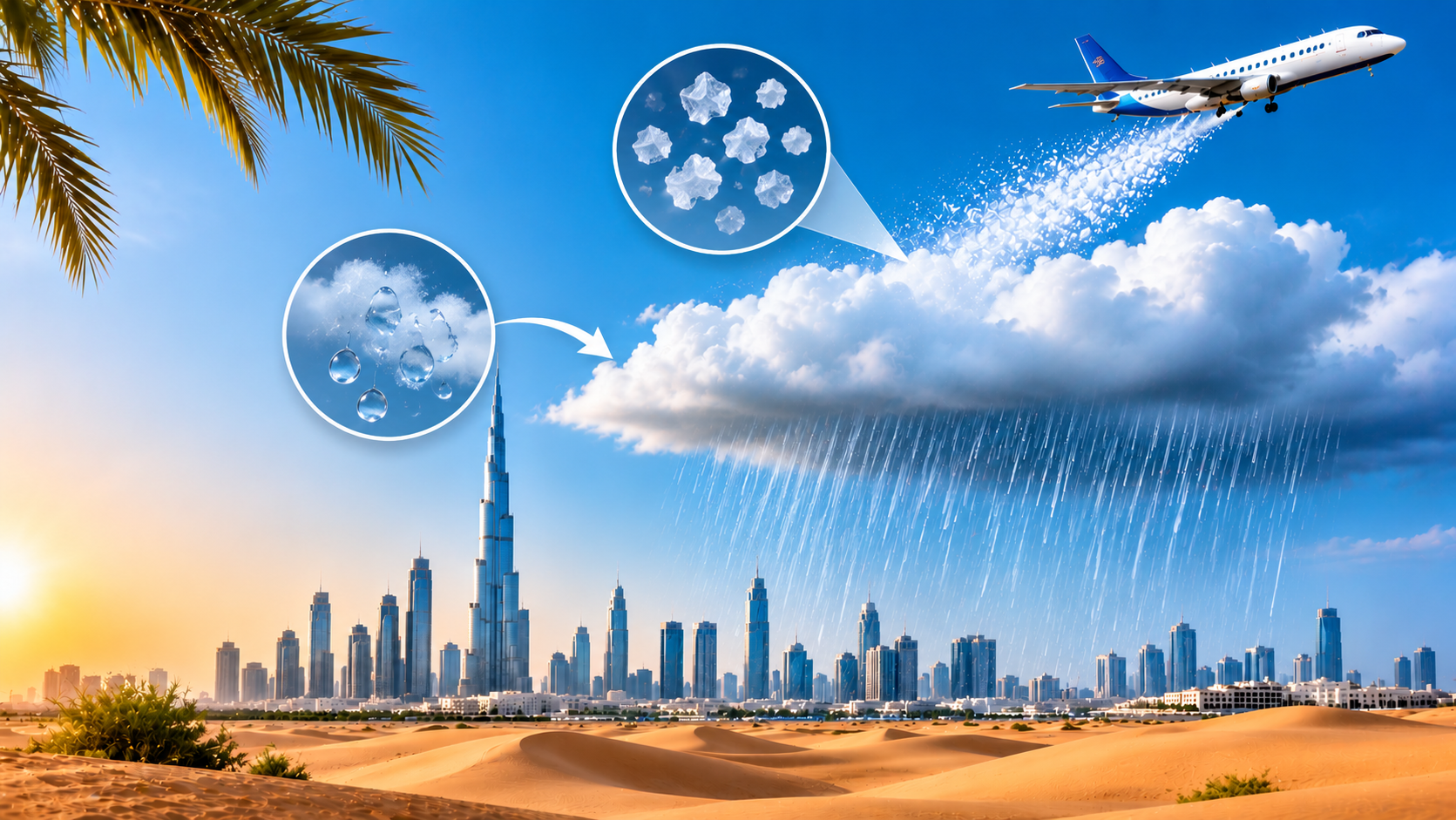
Cloud seeding is a weather modification technique that involves introducing tiny particles into suitable clouds to encourage the formation of water droplets or ice crystals.
These particles act as seeds around which water droplets or ice crystals can develop.
The main purpose is to increase the possibility of rainfall from clouds that already contain enough moisture and have suitable atmospheric conditions.
An important point to remember is that cloud seeding cannot create clouds from clear skies or guarantee rainfall. It works only when the natural conditions are appropriate.
Why Does the UAE Use Cloud Seeding?

The UAE has an arid climate, meaning it receives relatively little rainfall compared with many other countries.
Freshwater is essential for drinking, agriculture, industries, and everyday activities. Although desalination provides a major source of drinking water, improving rainfall and studying natural water resources are also important.
The UAE's National Center of Meteorology conducts cloud seeding operations and atmospheric research to better understand rainfall enhancement.
Cloud seeding is part of the country's broader efforts to explore innovative approaches to water security.
How Does Cloud Seeding Actually Work?
Cloud seeding involves several scientific steps. Let's understand the process in a simple way.
1. Scientists Identify Suitable Clouds
The first step is finding clouds with the right atmospheric conditions.
Scientists use weather radar, satellites, aircraft observations, and atmospheric data to study cloud development.
Not every cloud is suitable for seeding. Clouds need sufficient moisture and appropriate temperature conditions for the process to have a chance of working.
2. Special Particles Are Introduced
Once a suitable cloud is identified, aircraft or other approved delivery systems may introduce seeding materials.
One commonly used material is silver iodide, while certain operations also use salt-based particles.
The choice of material depends on the cloud type and the scientific method being used.
3. Water Droplets or Ice Crystals Develop
The seeding particles help provide surfaces or conditions that support the formation of water droplets or ice crystals.
In cold clouds, silver iodide can act as an ice-nucleating particle. It helps supercooled water droplets freeze into ice crystals.
In warm-cloud seeding, hygroscopic materials, such as certain salts, can encourage water droplets to grow by attracting moisture.
4. Droplets Grow Larger
As water droplets or ice crystals develop, they may collide or combine with other particles.
In suitable clouds, these particles can become large enough to fall through the atmosphere.
5. Rain Reaches the Ground
When water droplets or melting ice crystals become heavy enough to overcome rising air currents, they fall as precipitation.
This is how cloud seeding may help enhance rainfall under favourable atmospheric conditions.
What Science Makes Cloud Seeding Possible?
Cloud seeding is connected to several important scientific concepts.
Physics:
Physics helps scientists understand temperature, air pressure, humidity, atmospheric movement, and how water droplets behave inside clouds.
Chemistry:
Chemistry explains how materials such as silver iodide and salt particles interact with moisture and influence cloud processes.
Environmental Science:
Environmental science helps researchers study rainfall patterns, water availability, ecosystems, and the possible environmental impacts of weather modification.
Mathematics:
Scientists use mathematical models, weather measurements, and statistical analysis to evaluate cloud conditions and study whether seeding operations influence rainfall.
These subjects work together to make cloud seeding research possible.
Can Cloud Seeding Make Rain Whenever We Want?
No. This is one of the biggest misunderstandings about cloud seeding.
Cloud seeding cannot produce rain whenever scientists choose. It depends on naturally occurring clouds with suitable moisture, temperature, and atmospheric conditions.
It also cannot guarantee a specific amount of rainfall.
Researchers use observations and scientific analysis to understand whether seeding operations are effective.
This is why cloud seeding is considered a method of potential rainfall enhancement rather than a technology that controls the weather completely.
Is Cloud Seeding Safe for the Environment?
Environmental safety is an important part of cloud seeding research.
Scientists study the materials used in seeding operations, their concentrations, and their potential effects on the environment.
Silver iodide is commonly used in certain cold-cloud seeding programmes, while salt-based materials are also used in other approaches.
Ongoing monitoring and research help assess environmental impacts and improve operational practices.
Cloud seeding should always be evaluated through scientific evidence rather than assumptions.
What Can Students Learn from Cloud Seeding?
Cloud seeding is an excellent real-world example of how classroom science is used to understand complex natural processes.
Students can explore:
Physics: Temperature, pressure, humidity, and atmospheric motion.
Chemistry: Chemical particles, ice nucleation, and water properties.
Biology: The importance of rainfall for plants, animals, and ecosystems.
Environmental Science: Water conservation, climate, and weather modification.
Mathematics: Rainfall measurements, weather data, and scientific calculations.
These connections make science more interesting because students can understand how scientific knowledge influences the world around them.
Learn Science with Siri Education
Understanding cloud seeding becomes easier when students connect scientific theories with real-life examples.
At Siri Education, students receive live, one-on-one online tutoring in Physics, Chemistry, Mathematics, Biology, and Calculus for Grades 6–12.
From understanding atmospheric science to exploring chemical reactions and solving mathematical problems, personalised learning helps students develop stronger academic foundations.
If you are looking for Online Tutoring in United Arab Emirates, Siri Education offers interactive lessons and individual academic support to help students learn with confidence.
Final Thoughts
Cloud seeding is an interesting example of how science and technology can work together to address environmental challenges.
By introducing suitable particles into selected clouds, scientists attempt to encourage the natural processes involved in rainfall.
Although it cannot guarantee rain or control the weather, cloud seeding provides valuable opportunities for scientific research and water resource management.
The next time you see clouds above the UAE, remember that there is an entire world of Physics, Chemistry, and atmospheric science happening right above you!