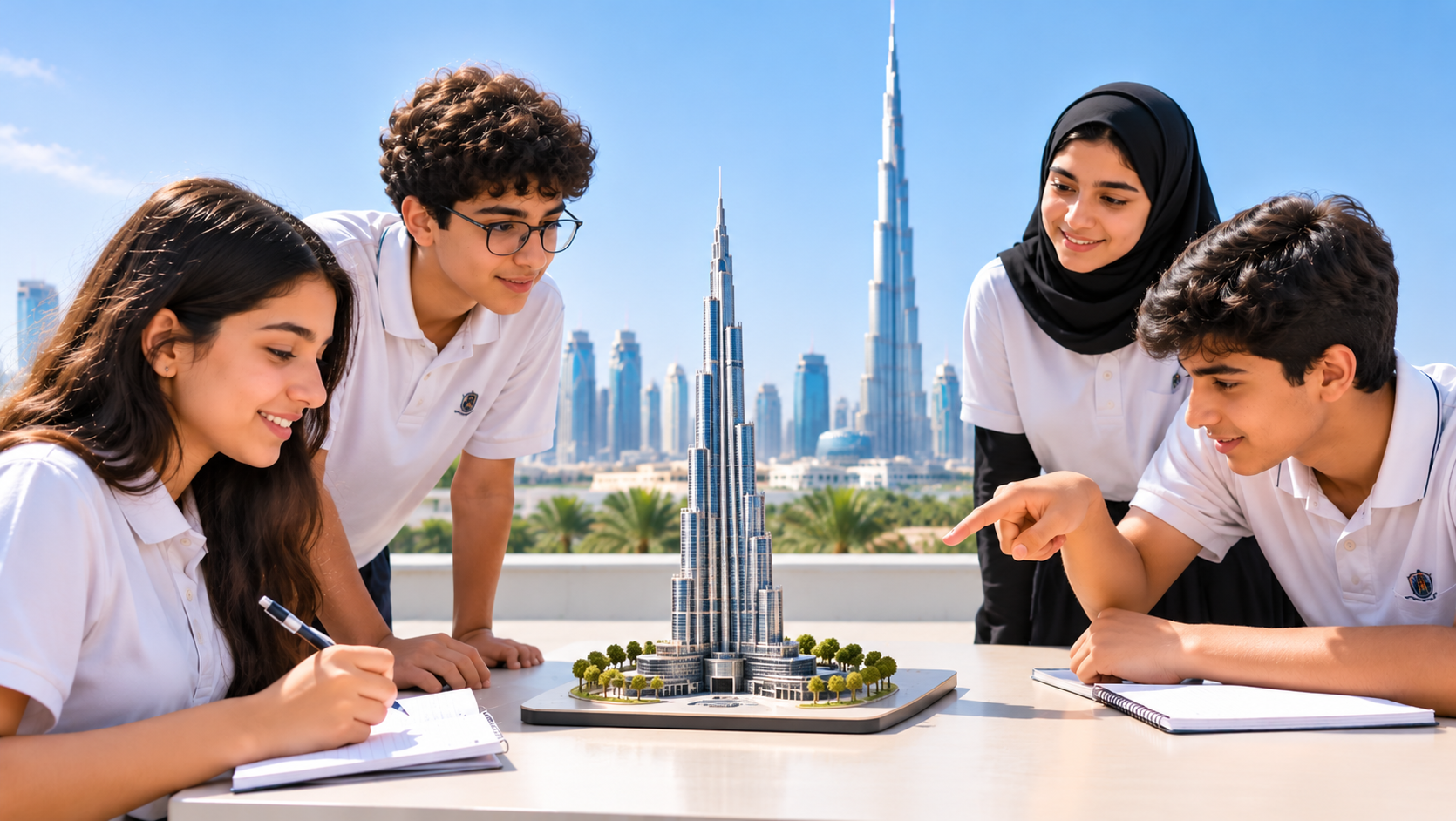
Standing at an incredible height of 828 metres, Burj Khalifa in Dubai is one of the most impressive engineering achievements in the world. Its towering structure dominates the city's skyline and attracts millions of visitors every year.
But have you ever wondered how such a massive building can stand so tall without falling over? How does it handle strong winds, gravity, and the enormous weight of its own structure?
The answer lies in engineering, physics, mathematics, and advanced construction technology.
Let's explore the science behind Burj Khalifa and discover how engineers design skyscrapers that reach extraordinary heights.
1. The Foundation: Building Strength from the Ground Up
Every skyscraper needs a strong foundation. The taller a building becomes, the more important its foundation is because it must safely transfer the enormous weight of the structure into the ground.
Burj Khalifa uses a reinforced concrete foundation supported by a large number of deep concrete piles.
These piles extend into the ground and help distribute the building's load across a wider area.
Engineers carefully studied the soil and rock conditions before designing the foundation.
Science connection: This is an example of physics in action. Gravity pulls the building downward, while the foundation transfers and distributes the resulting forces into the ground.
2. The Y-Shaped Design: A Smart Engineering Solution
One of the most recognisable features of Burj Khalifa is its Y-shaped floor plan.
This design is not simply for appearance. It provides important structural advantages.
The building has a central reinforced concrete core with three wings extending outward. Together, these elements form a strong structural system that helps the tower resist different forces.
The Y-shaped layout also provides stability while supporting the building's enormous height.
Science connection: Geometry and structural mechanics help engineers understand how shapes influence strength, stability, and the distribution of forces.
3. How Does Burj Khalifa Handle Strong Winds?
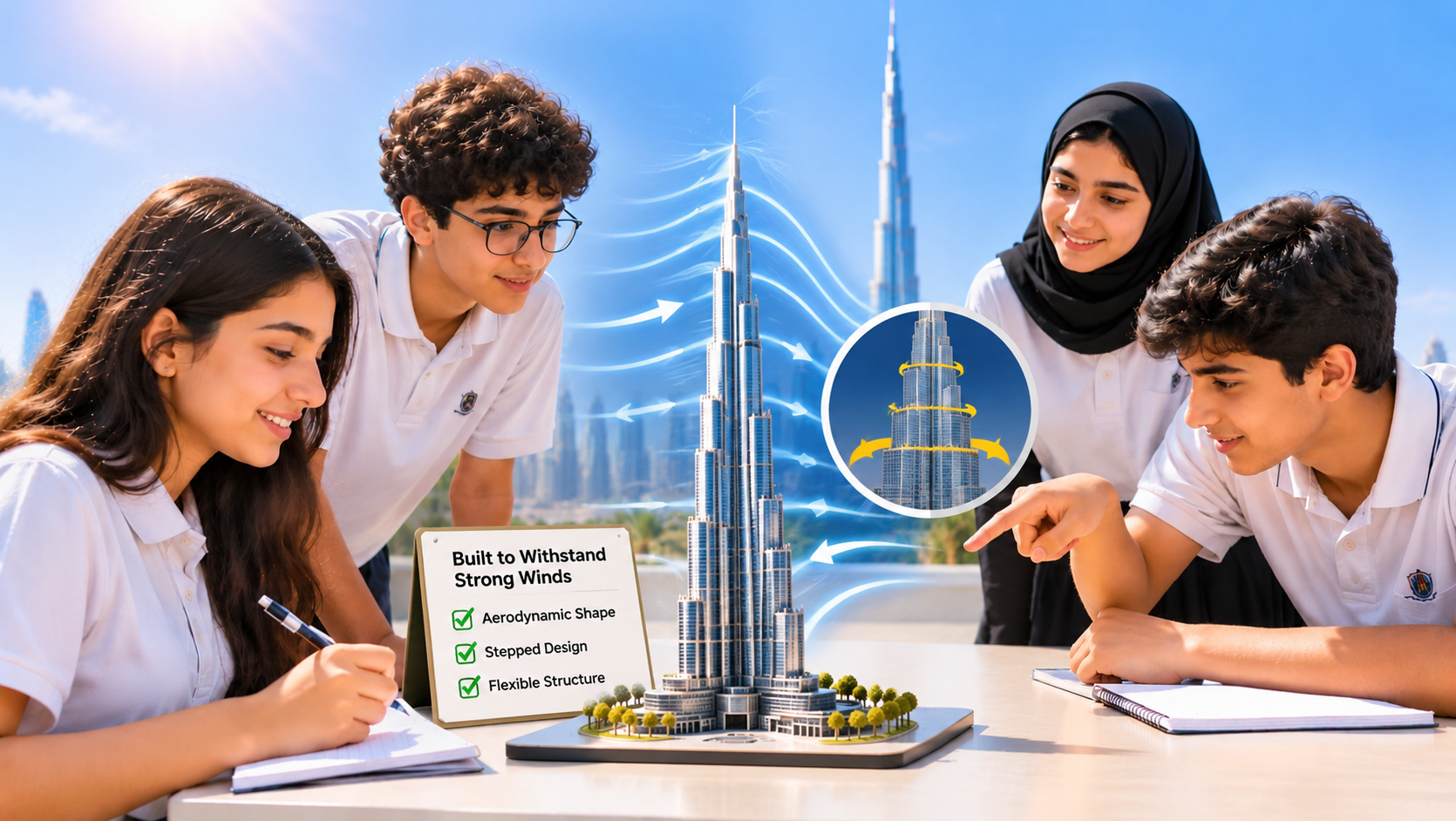
Wind is one of the biggest challenges when constructing extremely tall buildings.
As a skyscraper rises higher, it experiences stronger and more complex wind forces. These forces can push the structure from side to side.
Burj Khalifa uses an engineering strategy called the buttressed core structural system.
Its three-wing design provides support to the central core, helping the building resist lateral forces.
Another important technique is its stepped, spiralling shape. The changing building profile disrupts wind patterns and helps prevent strong, organised wind vortices from forming around the structure.
This reduces the risk of excessive wind-induced movement.
Science connection: Students can understand this concept through fluid dynamics, which studies how air and other fluids move around objects.
4. Materials That Make Skyscrapers Strong
The materials used in skyscrapers must withstand enormous forces and challenging environmental conditions.
Burj Khalifa uses reinforced concrete and structural steel in different parts of its construction.
Concrete is strong under compression, meaning it can support heavy loads. Steel is particularly useful because of its tensile strength, which allows it to resist pulling forces.
Combining these materials helps create a strong and durable structure.
Engineers also consider temperature changes, material expansion, and long-term performance when selecting construction materials.
Science connection: Material science helps explain why different materials behave differently under pressure, tension, and temperature changes.
5. The Role of Mathematics in Building Skyscrapers
Mathematics is essential at every stage of skyscraper construction.
Engineers use mathematical calculations and computer simulations to determine the building's dimensions, structural loads, material requirements, and stability.
Some important mathematical concepts include:
Geometry: Helps calculate the building's shape, angles, and dimensions.
Algebra: Supports calculations involving forces, loads, and structural measurements.
Trigonometry: Helps engineers analyse angles, heights, and structural relationships.
Calculus: Helps model complex changes in forces, movement, and structural behaviour.
Without mathematics, constructing a building as tall and complex as Burj Khalifa would be extremely difficult.
6. How Do Engineers Move People Around Such a Tall Building?
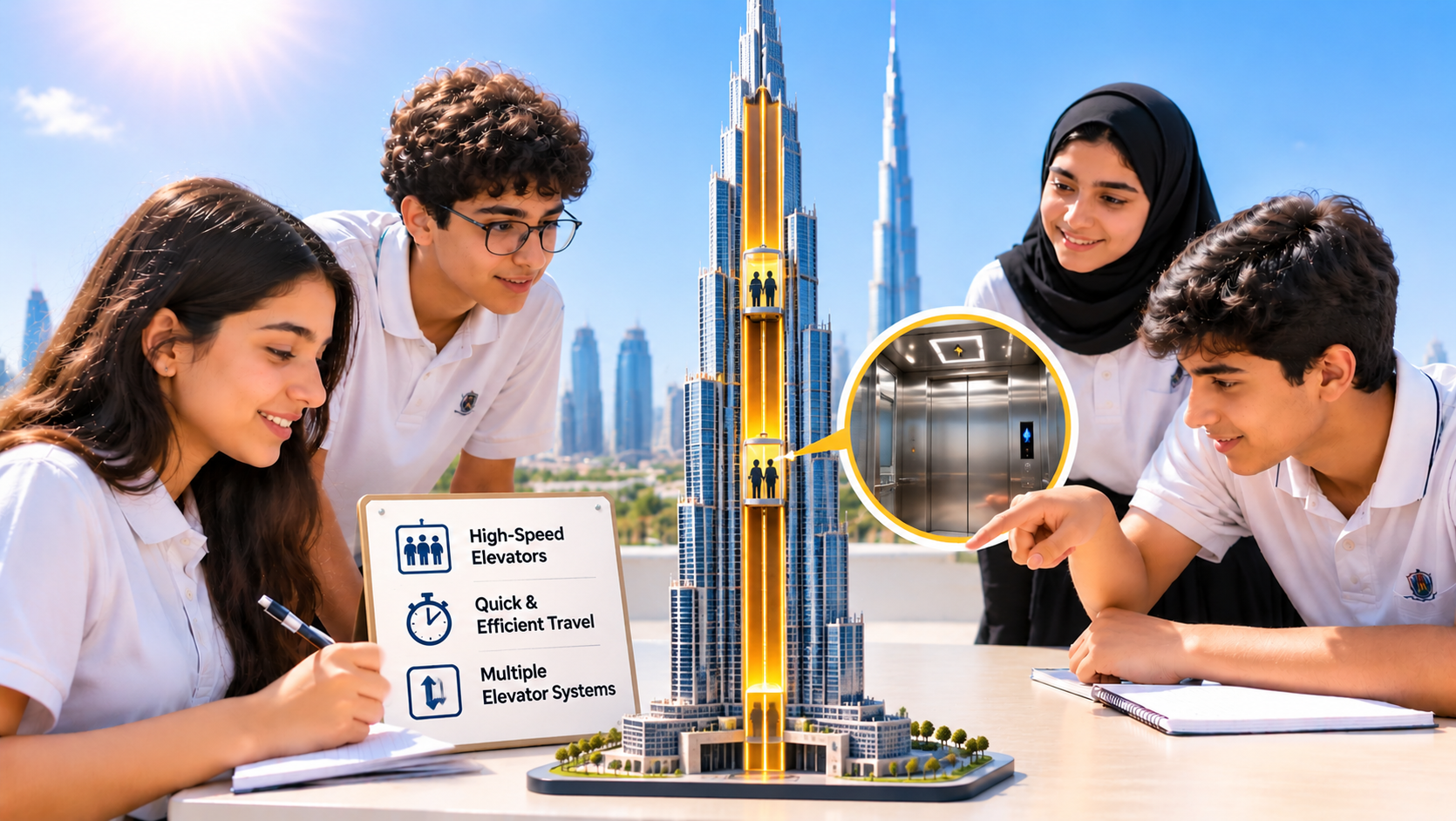
Another major challenge is transportation.
Imagine climbing hundreds of floors using stairs every day. It would be extremely difficult!
Burj Khalifa uses advanced elevator systems to transport visitors, residents, and employees between different floors.
Its vertical transportation systems are designed to manage high passenger demand while maintaining efficiency and safety.
Engineers must consider elevator speed, capacity, waiting times, and the building's overall layout when designing these systems.
This demonstrates how engineering is not only about making buildings strong but also about making them practical for everyday use.
7. What Can Students Learn from Burj Khalifa?
Burj Khalifa is an excellent real-world example of how different academic subjects work together.
Students can explore several important concepts:
Physics: Gravity, force, pressure, motion, and wind resistance.
Mathematics: Geometry, trigonometry, measurements, and calculations.
Chemistry: Properties of concrete, steel, and other construction materials.
Environmental Science: Energy efficiency, building design, and sustainable construction.
Engineering: Structural planning, problem-solving, and construction technology.
Learning through real-world examples makes difficult scientific concepts easier to understand and remember.
Learn Science and Mathematics with Siri Education
Understanding how skyscrapers work becomes easier when students connect classroom lessons with real-world examples.
At Siri Education, students receive live, one-on-one online tutoring in Physics, Chemistry, Mathematics, Biology, and Calculus for Grades 6–12.
From understanding gravity and forces to solving mathematical problems, personalised learning helps students build confidence and strengthen their academic knowledge.
If you are searching for Online Tutoring in United Arab Emirates, Siri Education offers interactive lessons and individual academic support to help students develop a better understanding of important subjects.
Final Thoughts
Burj Khalifa is much more than the world's tallest building. It is a remarkable example of how science, mathematics, and engineering can turn an ambitious idea into reality.
Its foundation, structural design, wind-resistant shape, and advanced materials all demonstrate how engineers solve complex problems.
The next time you look at Burj Khalifa, remember that behind its impressive height is a combination of scientific discoveries, mathematical calculations, and innovative engineering.